
Front Yard Guide
Front yard ideas that improve curb appeal without making the house disappear
A front yard should support the architecture, not fight it. The best front yard ideas usually bring more order to the approach, make the entrance easier to read, and shape planting so it frames the house instead of hiding it.
Front yards are deceptively hard because they carry a lot of visual responsibility in relatively little space. They need to create a good first impression, relate to the style of the house, and still feel manageable to maintain. The front yard often succeeds not through abundance, but through discipline.
Think about the approach first
Where does the eye go when someone arrives? A stronger path, clearer edges, or better planting around the entry can change the whole first impression.
One useful way to think about curb appeal is to imagine that the front yard is introducing the house. If the route to the entrance feels confusing or visually weak, the whole property feels less coherent. A well-defined path, a clearer planting frame, and a stronger threshold near the front door often create more impact than decorative elements spread across the entire lot.
Keep the facade readable
Overplanting the front of the house often makes the property feel smaller and messier. Good curb appeal usually comes from balance between structure and softness.
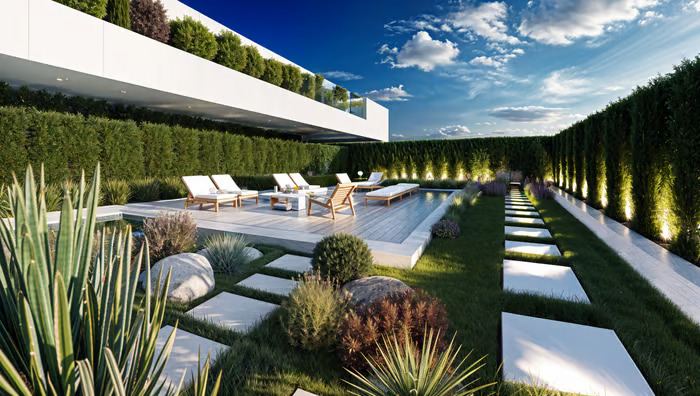
People often underestimate how much the building itself should remain visible. Plants should complement the facade, not erase it. If shrubs are too large, too many forms are competing, or the entry is buried, the front yard loses elegance. The strongest front yards make the architecture easier to understand.
Use planting to frame, not clutter
- Repeat shapes instead of mixing too many plant forms
- Let the front door or entry path read clearly
- Use one or two stronger focal moves
- Keep lawn, beds, and walkway edges legible
Planting in a front yard often works best when it feels like a set of calm repeated gestures rather than a collector’s display. Too many plant types create nervousness. Repetition creates confidence. That does not mean the front yard has to feel rigid. It means the composition needs a clear visual rhythm.
Pathways matter more than people expect
A path is not only practical. It tells the eye how to move and where to go. In front yards, the path can either strengthen the house or weaken it. A strong path usually does at least one of these things well:
- Aligns clearly with the entry
- Feels proportional to the scale of the house
- Creates a clean relationship with adjacent planting beds
- Makes arrival feel deliberate instead of accidental
Do not confuse more detail with better design
A front yard can feel expensive with fewer moves if those moves are clear. Better bed lines, stronger massing, more resolved planting height, and a cleaner threshold often outperform an overload of small accessories, ornaments, or mixed textures.
Consider the view from inside the house
People often judge front yards only from the street. But if you live there, the front garden is also part of the interior experience. The way the space looks from a window or front room matters. A cleaner front composition can make the whole house feel calmer from inside as well.
Think seasonally and structurally
Front yards are exposed to public view year-round. That means structure matters even when flowers are gone. Evergreen form, strong edging, deciduous branching, and clear hardscape relationships often carry the yard through the off-season more effectively than seasonal color alone.
A useful decision rule
If you are unsure whether something improves the front yard, ask whether it makes the arrival clearer, the house more legible, or the composition calmer. If the answer is no, it may be decoration without direction.